Scoring & Waves Explained
Mechanics reference · Updated September 16, 2026 · Applies to Circlegame v0.7
Circlegame hides no numbers. Every kill is worth the same, every wave follows the same timer, and enemies never despawn. This page documents the exact rules so you can plan a run instead of guessing — and it is the reference we update whenever balance changes land in the Dev Log.
How scoring works
| Event | Score effect | Notes |
|---|---|---|
| Kill a red ring enemy with a white bullet | +100 | The only way to score |
| Survive another second | +0 | No time bonus, no multiplier |
| Get touched by an enemy or a red bullet | Run ends | One hit, no health bar |
| Beat your previous best | Saved locally | Stored in browser local storage |
Because score is purely kills, the fastest way to a bigger number is not aggression — it is uptime: stay alive, keep the arena clear, and the kills accumulate on their own.
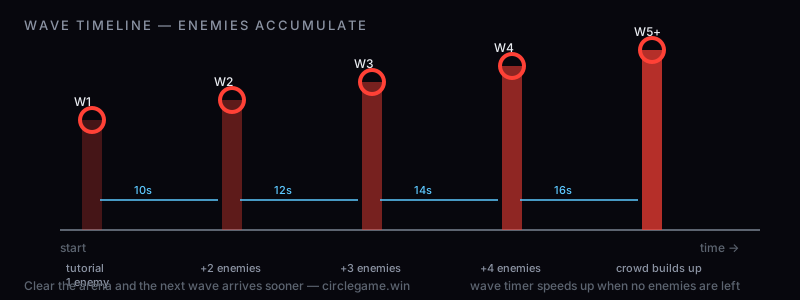
Wave interval formula
Once a wave has spawned, the next one is scheduled after:
interval = min(20, 8 + 2 × wave) seconds
- Wave 1 → wave 2: 10 s
- Wave 2 → wave 3: 12 s
- Wave 3 → wave 4: 14 s
- Wave 4 → wave 5: 16 s
- Wave 5 → wave 6: 18 s
- Wave 6 and beyond: 20 s (ceiling)
Wave 1 is a tutorial with a single enemy: the timer is paused until that enemy is killed, then held to at most 1.8 seconds before wave 2 spawns.
The empty-arena speed-up
If no enemies are alive and nothing is queued to spawn, the countdown runs at 2.2× speed. In practice:
| Nominal interval | Time to next wave if you clear immediately |
|---|---|
| 10 s | ≈ 4.5 s |
| 14 s | ≈ 6.4 s |
| 20 s | ≈ 9.1 s |
Enemies per wave
- Wave 1: 1 enemy (tutorial, timer pauses until it dies).
- Wave n (n ≥ 2):
min(n, 12)enemies, released one every 0.5 seconds. - Accumulation: enemies never despawn. Leftovers from earlier waves stay forever.
- Spawn side: always near the wall on the side opposite you, telegraphed 1 second early by a red warning dot.
- Movement: straight line, direction locked at spawn, bouncing off the wall; speed scales gently with wave number.
Full difficulty curve
| Wave | New enemies | Cumulative (if none killed) | Gap before next wave |
|---|---|---|---|
| 1 | 1 | 1 | paused → 1.8 s |
| 2 | 2 | 3 | 10 s |
| 3 | 3 | 6 | 12 s |
| 4 | 4 | 10 | 14 s |
| 5 | 5 | 15 | 16 s |
| 6 | 6 | 21 | 18 s |
| 7 | 7 | 28 | 20 s |
| 12+ | 12 | grows without limit | 20 s |
The curve is deliberately shallow: the game does not try to kill you with a spike, it tries to drown you in leftovers. That is why "clear before the wave" is the single highest-value habit (see Tips & Strategies).
What the numbers mean for strategy
- You control the pace. Kill fast and waves arrive fast. If you need a breather, leave one enemy alive and dodge.
- Leftovers compound. Three survivors from wave 3 plus the wave-4 spawn is a different game from six fresh enemies.
- The 0.5 s stagger is information. Count the spawns — knowing two more are coming stops you from committing to a bad line.
- Points are flat, so safety scales. There is no bonus for risky kills; a slow clean run outscores a fast reckless one.
Quick questions
How many points is a kill worth?
Exactly 100. No combos, no multipliers, no time bonus.
Can waves come faster than 20 seconds?
Yes — effectively, via the 2.2× empty-arena speed-up, which can deliver the next wave in under 5 seconds if you clear instantly.
Do enemies ever stop spawning?
No. The count per wave caps at 12, but waves never stop, and enemies never despawn.
Where can I see balance changes?
Every change is logged in the Dev Log, and the current values above always match the live build.
▶ PLAY CIRCLEGAME FREE